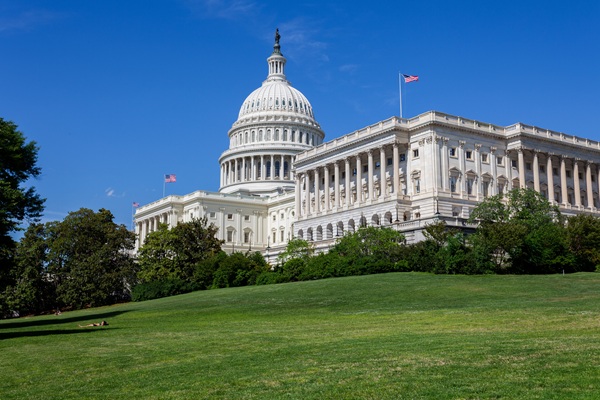
Democrats are preparing to take control of both chambers of Congress in January, setting the stage for a shift in federal cybersecurity policy. Following their midterm election victories, lawmakers are expected to step up oversight of the Trump administration's cybersecurity decisions and pursue efforts to restore federal cyberdefense capabilities.
A major focus will be rebuilding the Cybersecurity and Infrastructure Security Agency (CISA), which has lost roughly one-third of its workforce under the Trump administration and faced proposals for further budget cuts. Democrats are also expected to push for stronger federal cybersecurity protections as lawmakers confront growing concerns about AI-related threats.
Rep. Bennie Thompson, D-Miss., who is in line to chair the House Homeland Security Committee, described the transition as a "pivotal time for CISA." He has pledged to prioritize restoring the agency's staffing and its ability to help organizations defend against AI-enabled cyberattacks.
Congress Faces Deadline on Cybersecurity Information Sharing
One of Congress's most pressing cybersecurity issues is renewing the Cybersecurity Information Sharing Act of 2015, which provides liability protections for companies that share threat intelligence with the federal government and one another. The law's current authorization is set to expire Dec. 11 after a series of temporary extensions.
A longer reauthorization would give businesses more certainty about their ability to share information without facing legal exposure. But the legislation has encountered opposition from Sen. Rand Paul, R-Ky., who has repeatedly blocked efforts to extend it for multiple years.
Lawmakers could reach an agreement during the lame-duck session before Democrats take control in January. Otherwise, the incoming Congress will inherit the issue. Democratic control of the Senate could improve prospects for a long-term agreement, although Paul could still obstruct reauthorization.
“The law’s liability protections give companies the confidence to share threat and vulnerability information voluntarily, and the recent string of short-term extensions erodes that confidence,” said Doc McConnell, Head of Policy and Compliance at Finite State. “A multi-year reauthorization, whether it comes in the lame-duck session or early in the new Congress, would restore the predictability that voluntary sharing depends on.”
Rebuilding CISA and Protecting Critical Infrastructure
Cuts to CISA programs and services have strained its relationships with businesses and local governments. Although CISA has resumed hiring, Democrats are expected to investigate how the reductions have affected its ability to protect federal networks and support infrastructure operators.
The incoming Senate majority could also influence the agency's leadership. President Trump nominated Michael LoSapio, chief information security officer at Palantir Technologies, to serve as CISA director on Nov. 9. His nomination gives lawmakers another opportunity to examine the agency's direction through the confirmation process.
Democrats also want to revive the State and Local Cybersecurity Grant Program, whose authorization and funding have expired. The program helps state and local governments strengthen their defenses, particularly in sectors such as water utilities that often lack the resources to defend against sophisticated attacks.
The risks became apparent in late July, when water utilities in at least seven states reported cyber incidents to the FBI, according to a joint advisory from the agency and the Environmental Protection Agency. Some attacks disrupted operations after hackers accessed internet-connected industrial controllers and changed their configurations, leaving operators unable to monitor or control some equipment.
In the advisory, the FBI and Environmental Protection Agency recommended that operators remove industrial controllers from direct internet exposure, strengthen authentication, and restrict network access to authorized systems.
Congress Could Revisit Supply Chain Security Rules
Supply chain security could offer another area for bipartisan cooperation. Federal efforts to address security risks associated with foreign-made technology have produced a patchwork of regulations that can complicate compliance for businesses operating across multiple industries.
Congress may examine ways to reduce overlapping cybersecurity requirements without weakening protections against foreign technology risks. The Office of the National Cyber Director is already leading work on regulatory harmonization, although the Democratic majority has not announced a specific legislative proposal.
For businesses, more consistent rules could ease compliance burdens and make it easier to assess security risks associated with third-party technology.
AI Security Challenges Congress and Businesses
Although Democrats have expressed interest in addressing AI-related cybersecurity threats, they have yet to develop a unified legislative strategy. Congressional hearings and oversight could help shape future policy, along with ongoing AI security work by federal agencies such as the National Institute of Standards and Technology (NIST).
Meanwhile, the growing use of autonomous AI agents introduces security risks that businesses must address now. Depending on their permissions and configuration, these agents can make changes to applications and production environments with limited human oversight. Even when their access is properly authorized, they can cause damage by taking actions their operators never intended.
“What happens when a system with legitimate access makes a dangerous change?” said Ryan McCurdy, Vice President of Marketing at Liquibase. “An agent doesn't need to exploit a vulnerability to drop a production table. It just needs the right permissions.”
The risks posed by AI agents illustrate a broader challenge for businesses as Congress prepares to change hands. Federal cybersecurity policy may evolve under Democratic leadership, but organizations will still have to manage security threats while Washington debates its next steps.
“Regardless of where federal policy goes, organizations remain accountable for what reaches production,” McCurdy said. “The same standards should apply whether a change comes from a developer, an automated pipeline, or an AI agent.”